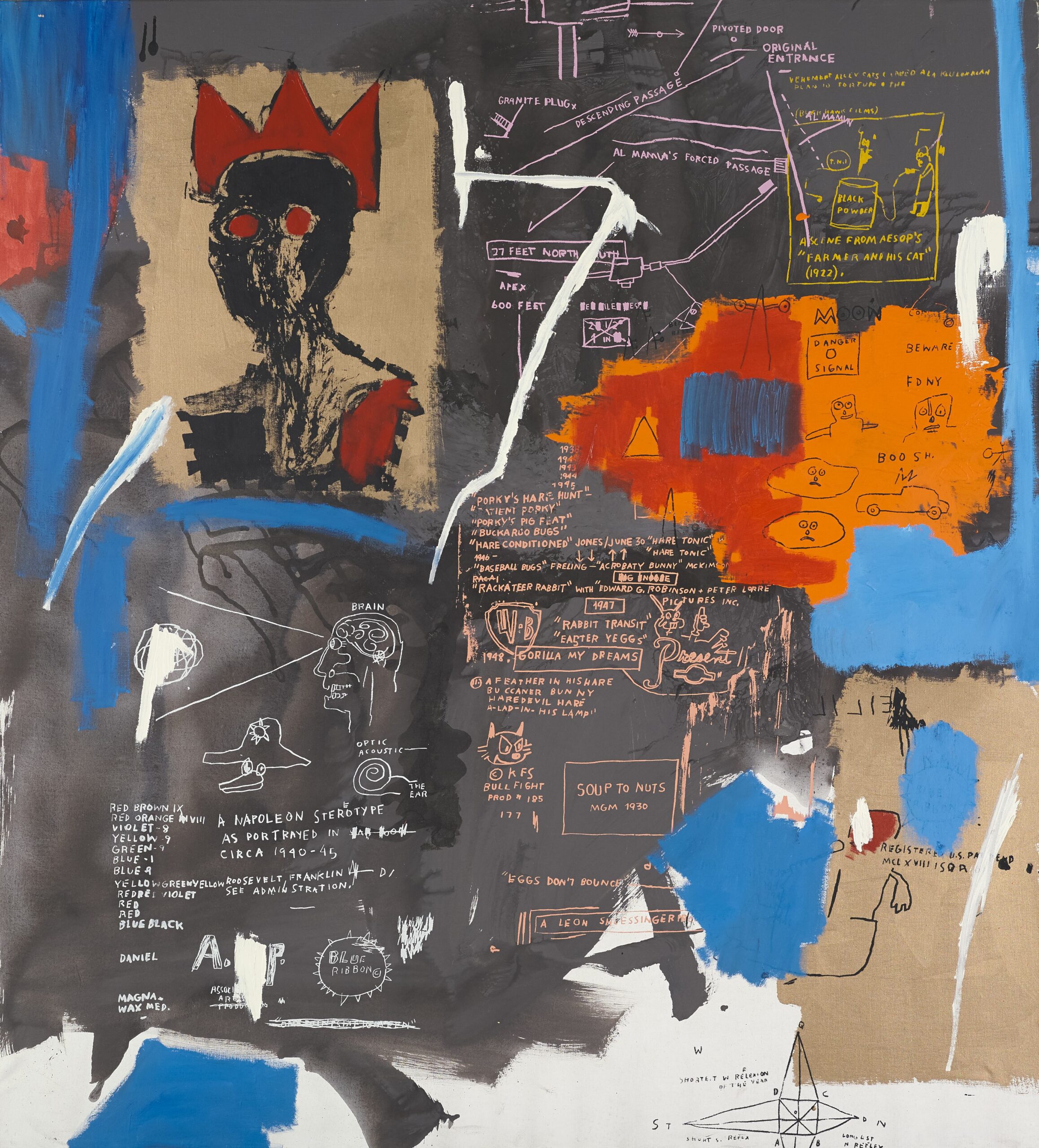
This exhibition brings to light Jean-Michel Basquiat’s rarely studied engagement with printmaking as central to his practice and as a site of innovation and collaboration. Conventional narratives around Basquiat (1960–1988) tend to emphasize his meteoric rise as a self-taught neo-expressionist prodigy, often placing him outside the art historical canon rather than in dialogue with postmodern ideas and artistic networks. In contrast, this exhibition reframes Basquiat’s legacy by centering his work in printmaking, a medium historically considered secondary to painting. It emphasizes his deep engagement with ideas around appropriation, identity, and reproduction, underscoring his intentional dialogue with postmodern strategies and repositioning him within a broader and more inclusive intellectual history. Through nearly 50 works of art, the project explores Basquiat’s relationship to generations of artists, from Leonardo da Vinci to Robert Rauschenberg, and with pioneering Black printmakers such as Bob Blackburn, revealing and celebrating a lineage of Black experimentation and intergenerational exchange in reproductive media.
Basquiat, the Blue Ribbons Paintings, and the Art of Reproduction is organized by the Princeton University Art Museum and curated by Jordana Moore Saggese, professor of modern and contemporary art and director of the David C. Driskell Center for the Visual Arts and Culture of African Americans and the African Diaspora, University of Maryland. The exhibition at Princeton was made possible by leadership support from The Richard C. von Hess Foundation and other generous donors.
Top image: Jean-Michel Basquiat. Blue Ribbon II, 1984. Acrylic, oil stick, and screenprint on canvas; 66 × 60 × 1 3/4 in. Private collection, L.2019.38.1. Artwork: © Estate of Jean-Michel Basquiat. Licensed by Artestar, New York. Image courtesy of Princeton University Art Museum
The Frist Art Museum is supported in part by