Anila Quayyum Agha: Interwoven
May 22–August 30, 2026
NASHVILLE, Tenn. (April 7, 2026)—The Frist Art Museum presents Anila Quayyum Agha: Interwoven, an exhibition spanning two decades of the Pakistani American artist’s multifaceted practice. Interwoven features mesmerizing installations, drawings, and sculptures that address some of the most urgent issues of our time. Organized by The Westmoreland Museum of American Art, the exhibition will be on view in the Frist’s Gordon Contemporary Artists Project Gallery from May 22 through August 30, 2026—the final stop on a four-venue tour.
Born in Lahore in 1965, Agha moved to the United States in 1999 and now resides in Indianapolis. Her experiences as a woman and an immigrant dealing with discrimination, invisibility, and oppression inform her art, as does environmental devastation. “I do not have a single story,” Agha says. “I have multiple stories that become interwoven to create a tapestry that is colorful, that is varied, that has pattern, that has beauty and light.” Her wide-ranging influences include the California Light and Space movement, Indo-Islamic architecture, Urdu poetry, and traditional crafts such as embroidery.
“Anila Agha is one of the most highly sought-after artists working in the United States today,” says Frist Art Museum Curator-at-Large Trinita Kennedy. “Her immersive installations elicit wonder and a sense of endless possibility.” Presenting 26 works of art drawn from major public and private collections, the exhibition surveys every period of Agha’s career and demonstrates the centrality of textiles to her practice.
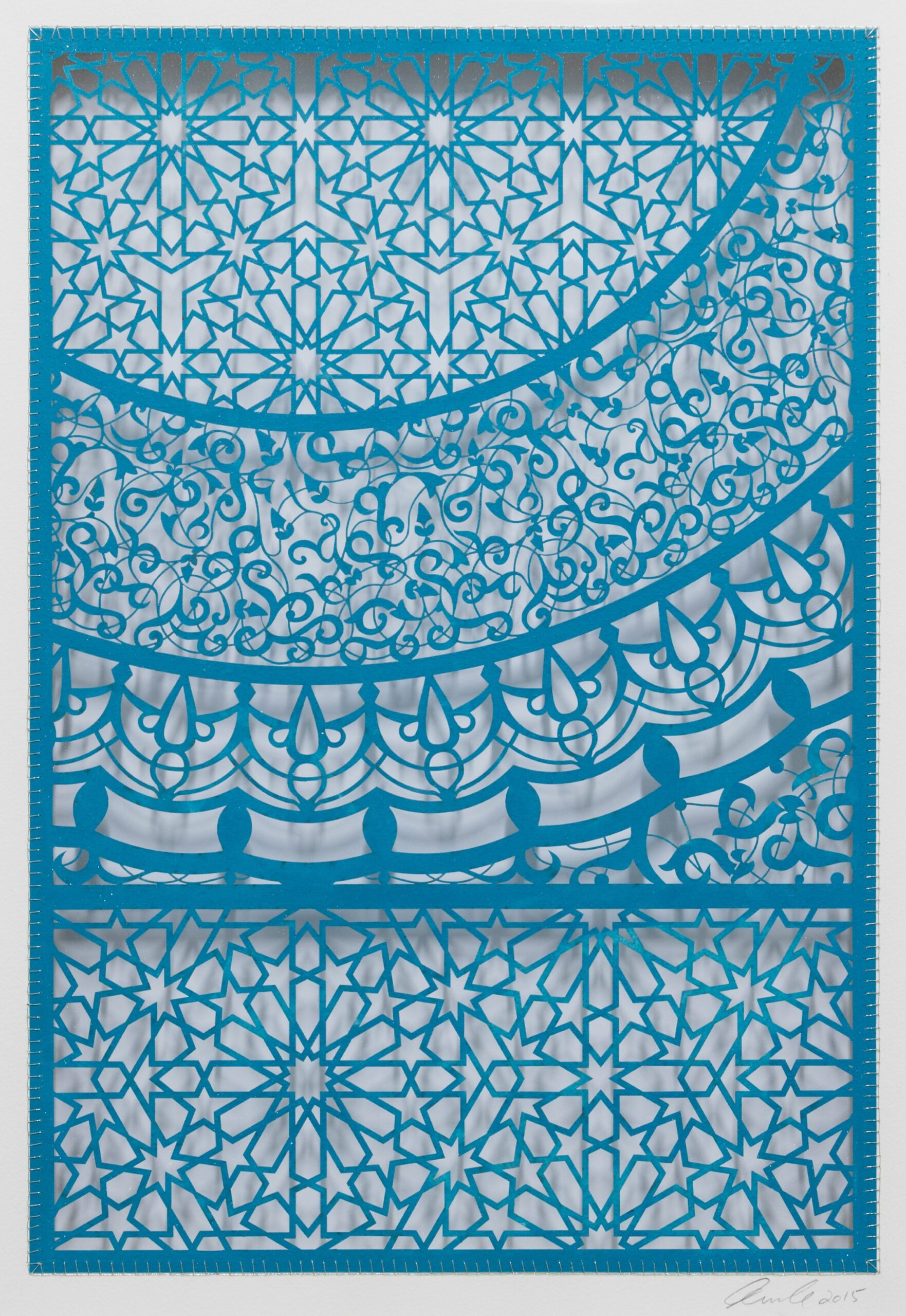
Interwoven opens with works created between 2004, her final year of graduate school, and 2011. “Already in this early period, Agha was experimenting with light-reflecting elements, such as glass beads and encaustic wax, along with sewing techniques,” writes Kennedy. While initially her work was monochromatic, Agha later embraced vibrant color as a vital means of self-expression. Intersections (Teal) and Intersections (Gold), both made in 2016, represent that important shift. Islamic pattern has also become more prominent in her work with time. “The star-and-hexagon motif in her Intersections series echoes the ornamentation of the Alhambra, a medieval Islamic palace in Granada, Spain,” writes Kennedy. “Agha alters the design with her color choices and by embellishing it with embroidery, an undervalued art form associated with women that she seeks to honor.”
Agha’s 2011 trip to the Alhambra proved to be a major turning point in her career. Christian, Jewish, and Muslim artists collaborated on the palace’s realization, and today anyone can visit it. Experiencing this firsthand was a revelation to Agha, since, as a woman in Pakistan, she had often been discouraged from entering Islamic mosques. Finding inspiration in the palace’s architecture and history, she began her Intersections series with a major installation of the same name. “Lit from within, it is a hanging cube that emits a starry geometric pattern in all directions. People of any background, gender, race, or religion can enjoy its ethereal beauty together,” writes Kennedy. Intersections won the 2014 ArtPrize in Grand Rapids, Michigan, and first brought Agha to international attention. She has since made more radiant lightbox installations, many of which have been acquired by museums and are frequently exhibited.
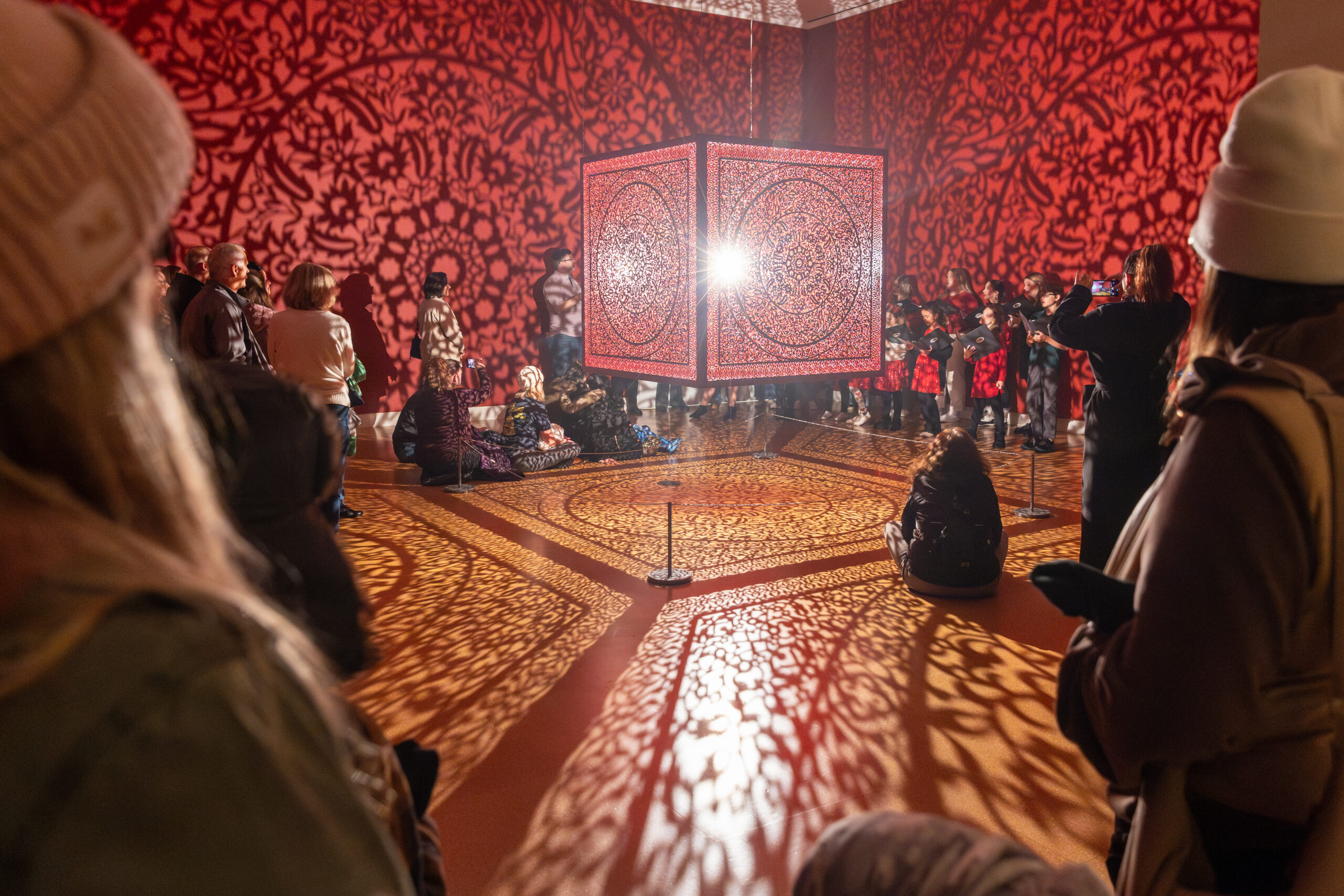
A centerpiece of this exhibition, All the Flowers Are for Me (Red), a lightbox belonging to the Cincinnati Art Museum, abounds with references to Pakistani cultural traditions. “Its dappled light effects recall jalis, the carved and pierced screens with ornamental patterns used in Indo-Islamic architecture. But, whereas jalis serve to divide women from men, Agha instead creates an inclusive space,” Kennedy explains. In this exhibition, the walls as well as the lightbox are a brilliant ruby red, which is the typical color of South Asian bridal gowns because of its associations with love and prosperity. The immersive installation bathes visitors in light and an intricate floral design, and they become a part of the art.
Making its debut in red in Interwoven is another powerful installation, A Flood of Tears (Gathering Storms), a work that emphasizes human interconnectedness and our duty to one another. Light shines on hundreds of hanging threads and sharp needles. Evoking of rainfall, the installation commemorates the devastating 2010 flood in Pakistan that affected 20 million people. Climate change, Agha notes, is unequal in its impact, affecting poor nations more than the wealthy ones mostly responsible for the greenhouse gas emissions causing the problem.
“I want to draw people into my artwork gently to stimulate dialogue,” Agha says. Through her intimately scaled drawings, sculptures, paintings, and installations, she creates sites of reflection and meditation for all to share.
The exhibition A Beautiful Despair: Anila Quayyum Agha will be on view concurrently at the Huntsville Museum of Art through August 23. Members of both the Frist Art Museum and the Huntsville Museum of Art will receive reciprocal admission through each museum’s respective exhibition dates.
Program
Artist’s Perspective: Anila Quayyum Agha
Friday, May 22, noon
Auditorium
Free for members; gallery admission required for not-yet-members. Registration is required.
Join artist Anila Quayyum Agha for an opening talk about her exhibition Interwoven, a survey spanning two decades of her multifaceted practice.
Exhibition Credit
Organized by The Westmoreland Museum of American Art, with generous support from the Henry Luce Foundation, the Terra Foundation for American Art, the Hillman Foundation, The Heinz Endowments, the National Endowment for the Arts, and the Fine Foundation
Supported in part by the Henry Luce Foundation, The Heinz Endowments, Terra Foundation for American Art, Hillman Foundation, The Fine Foundation, National Endowment for the Arts
Exhibition Supporters: Clay and Jeannie Blevins and the Gordon CAP Gallery Fund
The Frist Art Museum is supported in part by The Frist Foundation, Metro Arts, and the Tennessee Arts Commission, which receives funding in part from the National Endowment for the Arts.
FOR ADDITIONAL INFORMATION
Buddy Kite: 615.744.3351, bkite@FristArtMuseum.org
Connect with us @FristArtMuseum
About the Frist Art Museum
Accredited by the American Alliance of Museums, the Frist Art Museum is a 501(c)(3) nonprofit art exhibition center dedicated to presenting and originating high-quality exhibitions with related educational programs and community outreach activities. Located at 919 Broadway in downtown Nashville, Tenn., the Frist Art Museum offers the finest visual art from local, regional, national, and international sources in exhibitions that inspire people through art to look at their world in new ways. Information on accessibility can be found at FristArtMuseum.org/accessibility. Gallery admission is free for guests ages 18 and younger and for members, and $20 for adults. For current hours and additional information, visit FristArtMuseum.org or call 615.244.3340.