In Her Place: Nashville Artists in the Twenty-First Century
February 1–April 26, 2026
NASHVILLE, Tenn. (December 4, 2025)—The Frist Art Museum presents In Her Place: Nashville Artists in the Twenty-First Century, an exhibition spotlighting the central role women have played—and continue to play—in shaping Nashville’s visual arts community. Organized by the Frist Art Museum, the exhibition kicks off the Frist’s 25th-anniversary year and will be on view in the museum’s Ingram Gallery from February 1 through April 26, 2026.
Women artists and gallerists have long been at the center of Nashville’s vibrant visual arts community. Especially during the recent period of remarkable growth, an outsized number of local women artists are showing their work across the country and globe and receiving prestigious grants, residencies, and critical acclaim. Many have also dedicated years, even decades, to teaching or building impactful community organizations. Through the presentation of nearly 100 paintings, sculptures, textiles, and installation works made by an intergenerational group of 28 celebrated Nashville-based women artists, In Her Place draws attention to the prominent position of women artists in the region and beyond.
On view in the museum’s largest gallery space, In Her Place is part of the 2026 Tennessee Triennial for Contemporary Art, underscoring a commitment to the local arts ecosystem. The exhibition is cocurated by Sai Clayton, independent curator and artist; Katie Delmez, Frist Art Museum senior curator; and Shaun Giles, Frist Art Museum community engagement director. This project is accompanied by a catalogue coedited by Delmez and writer, editor, and independent curator Laura Hutson Hunter and published by Vanderbilt University Press.
Selected works relate broadly to concepts of place, whether that be the literal view of a garden outside a studio window, the more general influence of being raised in the American South, a place in time, or the evocation of an ancestral homeland outside of the U.S. The artists range from established leaders to emerging and midcareer figures, including María Magdalena Campos-Pons, Ashley Doggett, Raheleh Filsoofi, Jodi Hays, Alicia Henry, Sisavanh Phouthavong Houghton, Karen Seapker, Vadis Turner, Yanira Vissepó, and Emily Weiner.
In their exhibition catalogue introduction, Clayton and Delmez write, “The title In Her Place challenges the long-held exclusion of women from the art world by asserting that these artists belong in museums, in critical conversations, and at the forefront of contemporary art. And it asserts that each artist is making this place, Nashville, their own by reshaping it as a city not only for musicians but also for visual artists working at the highest caliber. Ten years in the making, In Her Place is an important recognition of the decades-long impact women artists have had in defining Nashville’s creative landscape.”
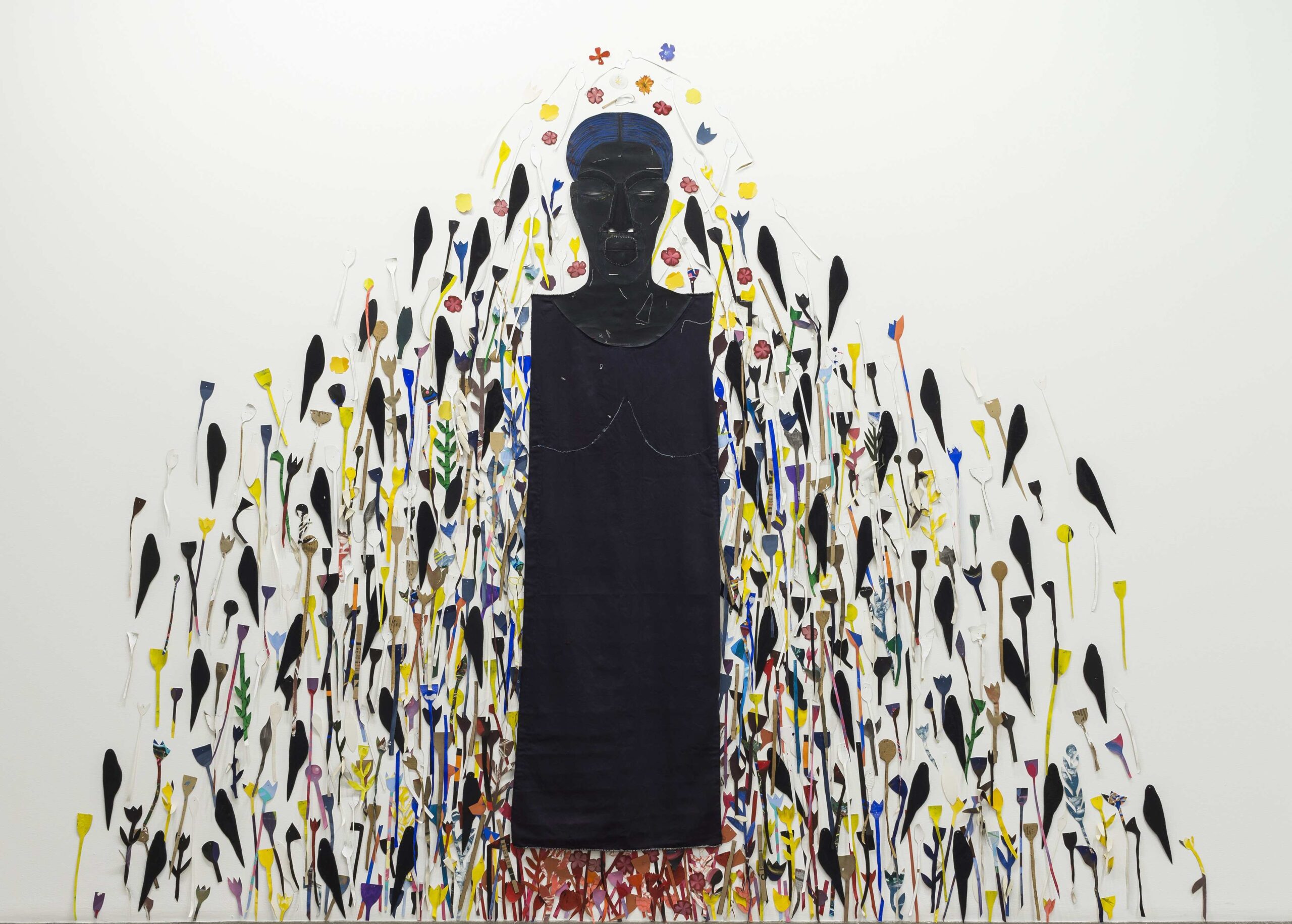
Organized thematically, In Her Place begins with a section titled “Materiality and Memory” and four works by Alicia Henry, who taught at Fisk University from 1997 until her death in 2024. In the exhibition catalogue, Jamaal Sheats, director and curator of Fisk University Galleries, writes of Henry, “Her legacy is one of quiet, unwavering impact. She didn’t seek recognition, but she shaped generations of artists through her guidance, her support, and her dedication.” Known for stitching together multilayered figures made from paper, leather, and fabric, Henry had an uncanny ability to bring her materials to life while addressing themes including family relationships, identity, and isolation.
The materials chosen by the artists featured in this section are central to their art-making practices; they creatively repurpose and transform them into representations of personal stories or shared traditions. Jodi Hays uses old cardboard, textiles, and found objects to consider the associations of those modest materials with class, region, and the history of art. Lakesha Calvin created a large sculpture out of wooden pallets to pay homage to her father’s labor, while Vadis Turner works with domestic materials such as bedsheets and curtains to disrupt gendered narratives.
In the following section, “Cultural Foundations,” artists examine their relationships to ancestral cultures and how they connect to their lives in Nashville. Tehran-born ceramicist Raheleh Filsoofi makes vessels and prints from clay gathered in Nashville and other U.S. cities. Briena Harmening, who was born and raised in Tennessee, explores aspects of Southern identity through text-based quilts that feature common colloquial expressions. Persian American artist Kimia Ferdowsi Kline blends Eastern ornamentation and symmetry with Western modernist and folk-art traditions to bridge cultures and tell layered stories. María Magdalena Campos-Pons and Yanira Vissepó maintain connections to the Caribbean, where they were both born, by featuring botanicals native to that region in their work.
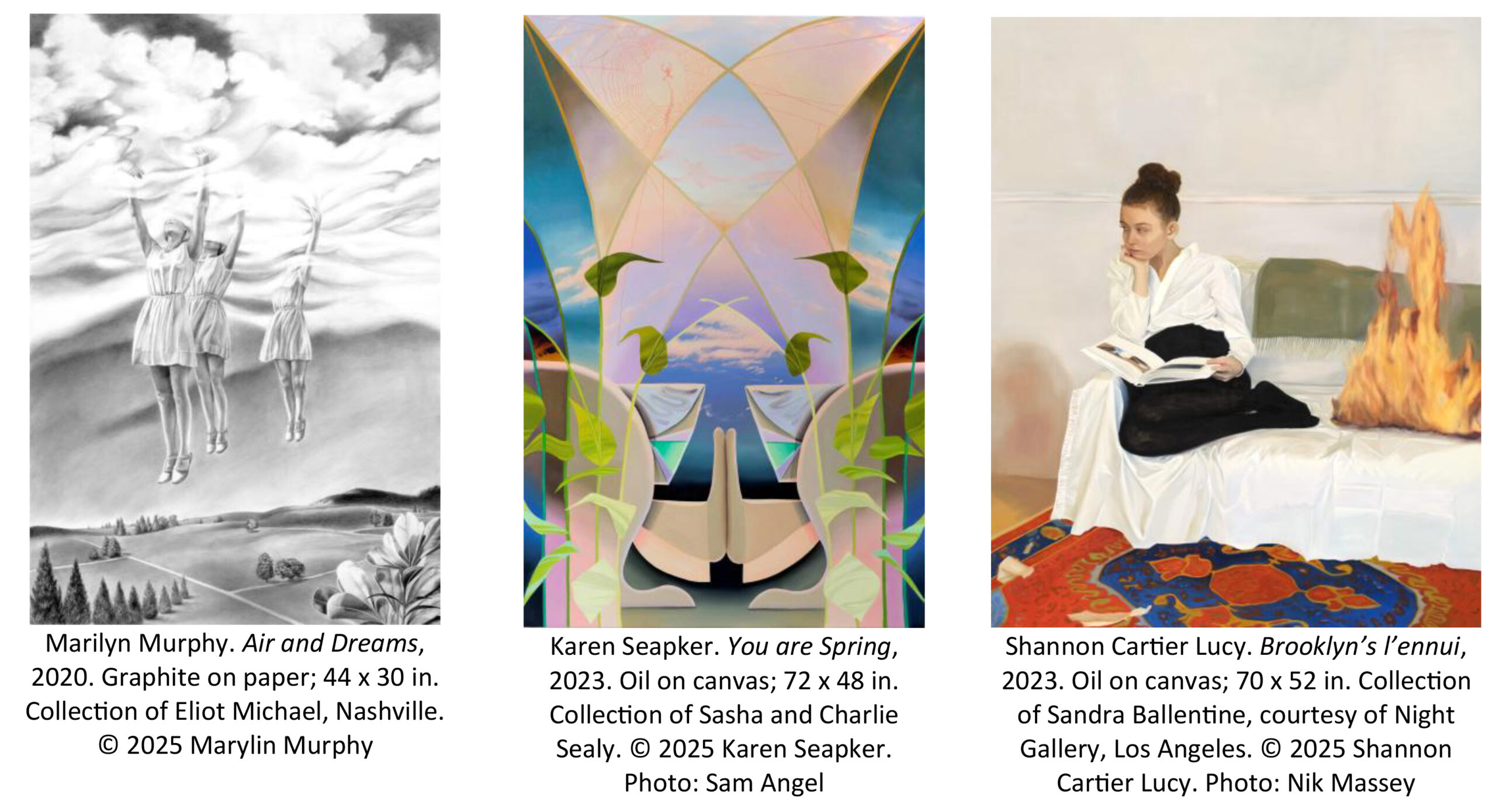
Artists in the next section, “Scenes and Dreams,” blend the familiar with the unexpected to create dreamlike worlds that explore topics such as history, domestic life, and the natural environment. Shannon Cartier Lucy turns ordinary scenes into surreal moments; in one work, a girl reads on the couch, unaware that it is on fire. With precisely rendered graphite drawings and paintings Marilyn Murphy sets otherwise recognizable scenes in impossible settings, imbuing them with a sense of the uncanny. Paintings by Emily Weiner and Karen Seapker feature identifiable elements, including Gothic architecture, human hands, and native plant life, but their stylization adds a distinct other-worldliness.
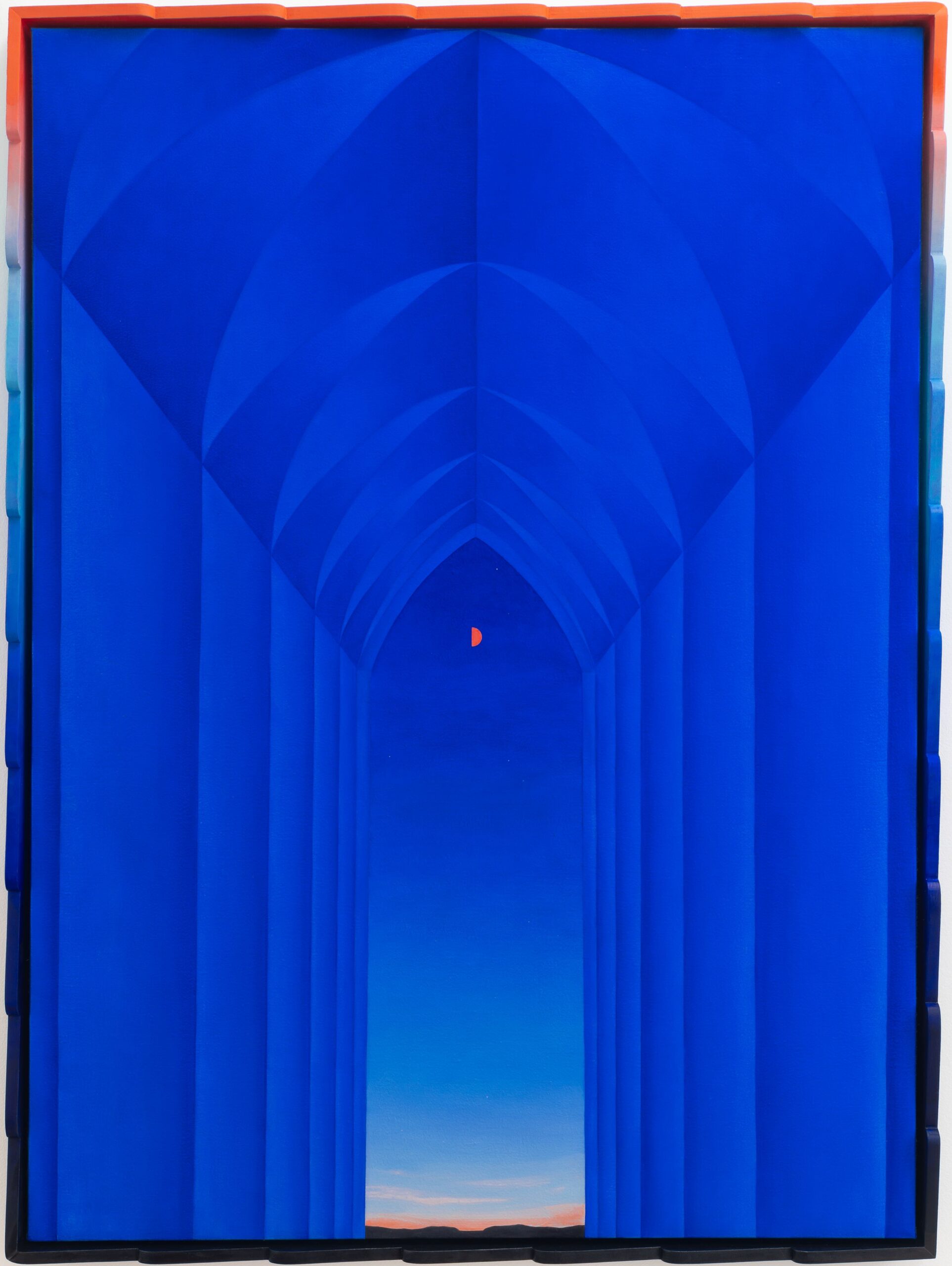
In the final section, “Patterns and Abstraction,” artists strip away representational details to focus on formal exploration. Carol Mode reconstructs the surfaces of her paintings with bright colors, shapes, and lines that interact with the textured brush strokes of their backgrounds. While they share an abstract language of complex geometric patterns, rich tactile surfaces, and vibrant colors, the works in this gallery express a variety of themes. Sisavanh Phouthavong Houghton’s dynamic compositions of saturated colors, undulating lines, and fragmented forms refer to her experiences as a Laotian refugee and to the chaos and disruption of war. Evoking memory and family, the patterns in Kelly S. Williams’s carefully rendered tondos are derived from her late grandmother’s collection of domestic textiles.
Related Projects
In association with In Her Place, the exhibition Sistah Griot: The Iconoclastic Art of Barbara Bullock, organized by the Frist Art Museum with guest curator Carlton Wilkinson, will be on view concurrently in the Frist’s Gordon Contemporary Artists Project Gallery. The exhibition showcases the incisive and still-timely work of the late Nashville-based artist Barbara Bullock (1949−1996) and highlights the imprint she left on Nashville.
In the Frist’s Turner Courtyard, a large abstract sculpture by Vadis Turner titled Venus in a Landscape will be installed in the center of the planter structure between existing cherry trees. The sculpture is a reinterpretation of an Italian Renaissance painting of a reclining Venus, the Roman goddess of love, in a distorted grid form, and will be on view for several years.
To document the In Her Place artists’ voices, Frist staff members traveled around Nashville to film interviews with many artists in their studios. Focusing on each artist’s wider practice and their relationship with Nashville, the videos will be featured alongside works in the galleries and available on FristArtMuseum.org.
In Martin ArtQuest, the Frist’s award-winning art-making space, the new interactive stations will be thematically connected to In Her Place and feature collaborations with exhibiting artists. Guests are invited to make quilt-inspired paper collages at a station developed with Briena Harmening and use pipe cleaners to create soft sculptures inspired by Vadis Turner’s work. The stop-motion animation station will include backgrounds featuring Yanira Vissepó’s studio and the Frist Art Museum’s building. Magnets designed with Lanie Gannon will be featured on the Magnet Wall, and, at the Drawing in the Round station, imagery and materials from selected works in the exhibition will be on view for guests to draw.
For the duration of In Her Place, the five large bollards outside of the Frist’s Turner Courtyard entrance will be wrapped with imagery of selected works in the exhibition.
Artists in the Exhibition
Beizar Aradini
Alex Blau
Jane Braddock
Lakesha Calvin
María Magdalena Campos-Pons
Ashley Doggett
Raheleh Filsoofi
LiFran Fort
Lanie Gannon
Lauren Gregory
Kristi Hargrove
Briena Harmening
Jana Harper
Jodi Hays
Alicia Henry
Mandy Rogers Horton
Kimia Ferdowsi Kline
Shannon Cartier Lucy
Carol Mode
Elisheba Israel Mrozik
Marilyn Murphy
Sisavanh Phouthavong Houghton
Kit Reuther
Karen Seapker
Vadis Turner
Yanira Vissepó
Emily Weiner
Kelly S. Williams
Exhibition Catalogue
Available in the Frist’s gift shop, the accompanying 168-page hardcover exhibition catalogue, In Her Place: Nashville Artists in the Twenty-First Century, is published by Vanderbilt University Press and edited by Kathryn E. Delmez and Laura Hutson Hunter. The exhibition and catalogue chart a network of artists working at a high caliber with deceptively specific criteria—they are all women, and they are all based in Nashville, Tennessee. Working with diverse styles, subjects, and media, the artists of In Her Place are legion. They include a Tehran-born sculptor making vessels out of Tennessee red clay, an artist from Arkansas working with cardboard and references to unsettling histories, and a Nashville-born painter whose images of civil rights–era sit-ins read just as poignantly in 2026 as they would have in 1960. If anything ties these artists together, it is not their gender or their location, but rather their shared ingenuity and the comfort with which they subvert.
Program
Artists’ Conversation: The Foremothers
Featuring Jane Braddock, LiFran Fort, Lanie Gannon, Carol Mode, and Marilyn Murphy
Moderated by cocurator Sai Clayton
Thursday, March 12, 6:30 p.m.
Auditorium
Free for members; $10 for not-yet-members
Registration required
Join us for a special evening of conversation with five celebrated artists featured in In Her Place: Nashville Artists in the Twenty-First Century. Jane Braddock, LiFran Fort, Lanie Gannon, Carol Mode, and Marilyn Murphy will share insights into their decades-long artistic practices, the evolving landscape of the city’s art scene, and the deeply personal connections between their work and the notion of place.
Begin the evening with a live musical performance by Timbre Cierpke in the Grand Lobby from 5:15 to 6:15 p.m.
The museum will remain open until 9:00 p.m. to allow guests time to visit the galleries after the conversation.
Schedule of Events
5:15–6:15 p.m.: Music in the Grand Lobby with Timbre Cierpke
6:30–7:30 p.m.: Artists’ Conversation: The Foremothers
Exhibition Credit
Organized by the Frist Art Museum and cocurated by Sai Clayton, independent curator and artist; Katie Delmez, Frist Art Museum senior curator; and Shaun Giles, Frist Art Museum community engagement director
This exhibition is part of the Tennessee Triennial
Platinum Sponsor: HCA Healthcare/TriStar Health
This project is supported in part by The William Stamps Farish Fund and is funded under an agreement with the State of Tennessee administered by the Tennessee Commission for the United States Semiquincentennial.
Education and Community Engagement Supporter: Windgate Foundation
Spanish translations for this exhibition are supported in part by the Center for Latin American, Caribbean, and Latinx Studies at Vanderbilt University
The Frist Art Museum is supported in part by The Frist Foundation, Metro Arts, and the Tennessee Arts Commission, which receives funding in part from the National Endowment for the Arts.
Connect with us @FristArtMuseum #TheFrist
FOR ADDITIONAL INFORMATION
Buddy Kite: 615.744.3351, bkite@FristArtMuseum.org
About the Frist Art Museum
Accredited by the American Alliance of Museums, the Frist Art Museum is a 501(c)(3) nonprofit art exhibition center dedicated to presenting and originating high-quality exhibitions with related educational programs and community outreach activities. Located at 919 Broadway in downtown Nashville, Tenn., the Frist Art Museum offers the finest visual art from local, regional, national, and international sources in exhibitions that inspire people through art to look at their world in new ways. Information on accessibility can be found at FristArtMuseum.org/accessibility. Gallery admission is free for visitors ages 18 and younger and for members, and $20 for adults. For current hours and additional information, visit FristArtMuseum.org or call 615.244.3340.